Greta Thomas
Game Programming


Projects Outside Unreal Engine
Take Heed: Twine Game


Or, How the Dark Wizard Zabraxas was slain by the Knight Wyliam of Maplemouth but did not die, and how he was wroth and desired revenge, and how through the Knight's page he deceived and overcame him.
Team & Scope:
Engine: Twine, HTML, CSS
Team Size: Solo
Timeline: 3 Weeks, fall 2024
Role and Responsibilities
-
Created 10 pitches for browser-based narrative games
-
Researched Arthurian texts to write genre-accurate prose
-
Drew all assets, used CSS to add flair to pages
Challenge: Creating Meaningful dialogue choices
I wanted to take advantage of the written medium of roleplaying games. In Take Heed, you play as an evil wizard trapped inside an amulet. You cannot walk around and exact revenge on your own. You must manipulate a weak-willed page into doing it for you.
Challenge: Writing Historic Prose
I gathered several resources to write better historic prose:
-
the game Pentiment influenced both writing and artstyle
-
author Daniel Lavery, who combines comedy writing with intense historic research and literary references
-
Thomas Malory's Le Mort D' Arthur. I read much of the original Arthurian texts to write more colorful prose. I was especially inspired by its long chapter titles, and incorporated them into the Twine game

(Daniel Lavery)


Pentiment influenced both the game's textual and visual style

Joke based on the literary trope of twelfth century knights coming back from the crusades with oranges as trophies
Scale: The Great Oak Processing
First experience with game programming. "Infinite Climber" where you play as a lizard scaling an infinite oak while eating flies and avoiding enemies. I came up with this project because of my desire to learn procedural animation for the lizard's body.
Team & Scope:
Engine: Processing
Team Size: Solo
Timeline: 2 Weeks, fall 2024
What I learned:
-
Programming Forward and Inverse kinematics (FABRIK solvers)
-
Learned object-oriented programming. Created "Segment" objects that made up the lizard's body.
-
How to access code from Github (referenced This sample project to learn how procedural movement is handled behind the scenes)
-
Physics programming and collisions
-
Vector math

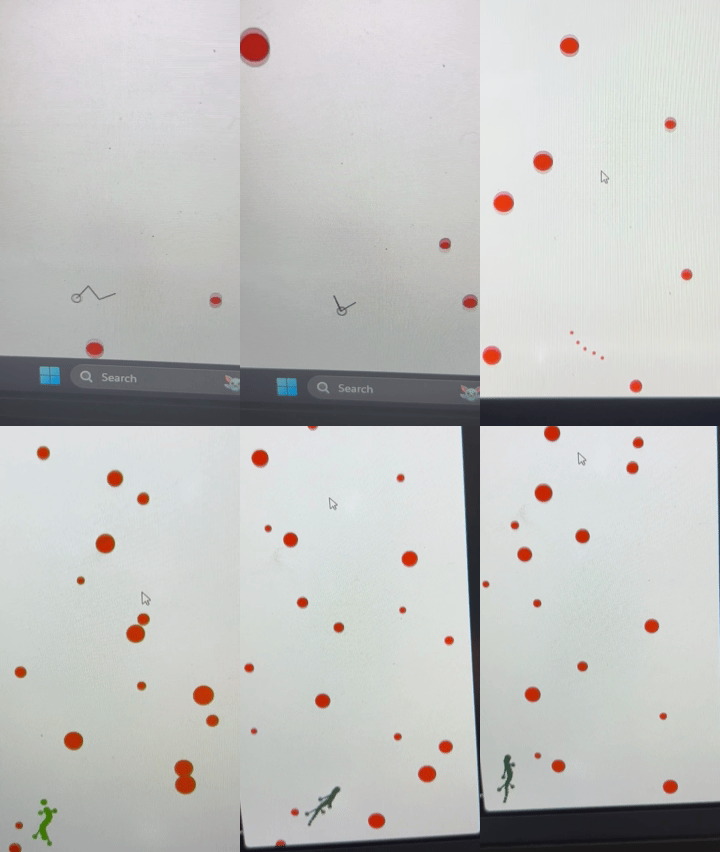

The lizard did not look very promising in the early stages of the project, but I am glad I stuck with it and proud of the result.
Daniel Schiffman's Kinematics series was a helpful reference
This reference was especially helpful as it supplied processing code
Get In, Get Out: Board Game
Get in, Get out is a heist board game where players need to work together and race against the clock to crack cryptic codes and plan the perfect heist.
Team & Scope:
Medium: Board game
Team Size: 5 members
Timeline: 4 weeks, Winter 2025
Recognition: SCAD Entelechy best board game 2025 finalist

Role and Responsibilities:
-
Pitching our core "heist" aesthetic and gameplay
- Revising and formatting rule book, creating visual gameplay guides
- Designing symbols


I designed our rulebook and created visual aids. Our gameplay was complex, so it was important to show clear visuals.


Symbols had to be described to and identified by other players, so they needed to be interesting and difficult to verbally differentiate from each other.
The Hacker symbols I designed can all be described as:
"Two Semi-circles with a line going through them, resembling an eye"


The Mastermind symbols I designed can all be described as:
"A money sign with a dot" (Rupee, Yen, Dollar, Euro, Pound)
"A letter with two lines cutting through it and a dot"
I included at least two of each money type in the pool and tried to make many of them resemble figures or faces, so that players could use poses and expressions to identify them.